

You search your own trade and your own town, and you’re nowhere. Someone two streets away is sat in the map at the top. If your business isn’t showing up on Google Maps, it’s almost never bad luck. It’s one of about five things, and most of them you can fix yourself this week.
Here’s what’s actually going on.
What you’re actually trying to get into
Search something like plumber Bradford and Google shows a small map with three businesses under it. That block is called the map pack. It sits above the normal results, and it’s where most of the calls come from.
Three slots. That’s it. Everyone else is on a second screen nobody taps.
What decides those three slots isn’t your website. It’s your Google Business Profile, which is the free listing Google keeps about your business. Getting into the map pack is really about getting that profile right.
Why your business isn’t showing up on Google Maps
Work through these in order. Most businesses fall over on the first two.
You haven’t claimed the profile
Google often creates a listing for a business before the owner does, from phone directories and old records. It sits there unclaimed, half wrong, ranking nowhere.
Search your business name on Google. If something comes up with a Claim this business or Own this business link, that’s yours and you need to take it. You do it at Google Business Profile. Google posts a postcard to your address with a code on it. Annoying, takes a week, but there’s no way round it.
The profile is half empty
A name, a phone number and nothing else won’t rank. Google needs to know what you do before it can show you to someone asking for it.
The parts that matter most are your main category, your list of services, your hours and your photos. Pick the category that matches what you actually do, not the nearest broad one. Emergency plumber and plumber are different categories and they rank for different searches.
Your details don’t match everywhere else
This is the quiet one that holds most businesses back. Google checks your name, address and phone number against everywhere else they appear online. Your website, Checkatrade, Yell, your Facebook page, old directory listings.
If your old mobile number is still on three directories, or your business is Smith Plumbing on one and Smith Plumbing Ltd on another, Google isn’t sure it’s looking at one business. When it isn’t sure, it doesn’t put you in the map.
Pick one version of your details and make everything match it, character for character. It’s boring and it works.
You’ve got no reviews, or they’ve dried up
Reviews are the single biggest thing separating the three in the map from everyone underneath. Not just how many, but how recent. Forty reviews from 2023 counts for less than twelve from the last three months.
Reply to them as well, good and bad. Google reads the replies, and so does the next customer deciding whether to ring you. Getting reviews coming in steadily is a job in itself, but it’s the one with the clearest payoff.
The profile’s gone quiet
Google watches whether a profile is being looked after. No posts, no new photos, last year’s Christmas hours still showing. That reads like a business that’s packed it in, and it gets ranked like one.
Want someone to go through your profile and tell you which of these is holding you back? We’ll do it on a free call, no charge and no pitch.
Distance matters more than people expect
Here’s the bit that catches people out. The map results change depending on where the person searching is stood.
Someone in the centre of town gets a different three businesses than someone five miles out. So you can be sat at the top for people near you and completely invisible to someone the other side of the same town.
Two things follow from that. First, don’t judge your ranking by searching from your own kitchen, because Google already knows where you are. Second, if you cover several towns, one profile won’t carry you across all of them. That’s where your website earns its keep, with a proper page for each area you work in.
What to do this week
An hour, start to finish, and you’ll have covered most of it.
- Search your business name and claim the listing if it isn’t already yours.
- Check your main category is the closest match to what you actually do.
- Add every service you offer, in the words a customer would use.
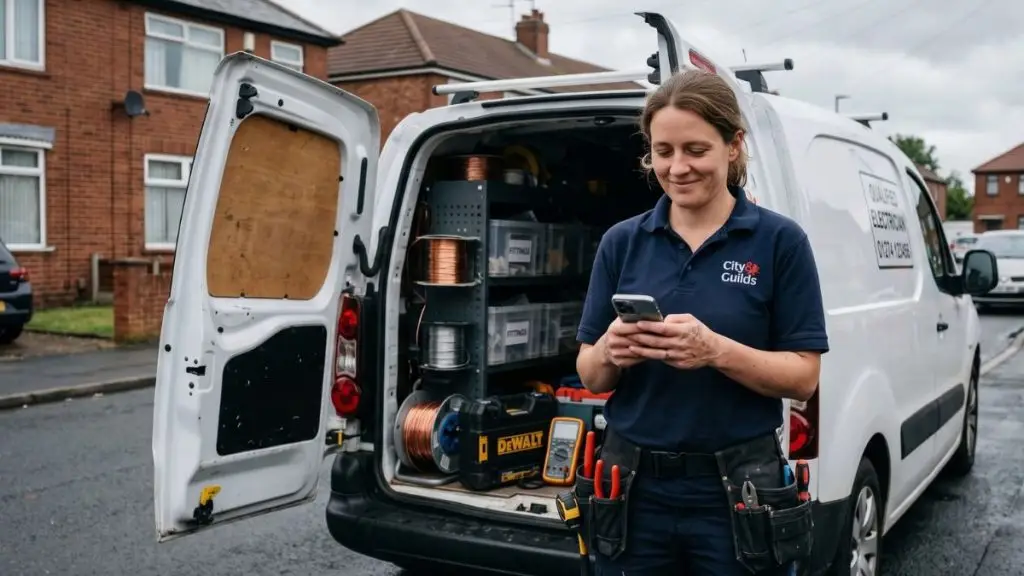
- Put up ten photos of real jobs. Your van, your work, your team. Not stock.
- Check your name, address and phone number match your website exactly.
- Ask your last five customers for a review. Just ask, most people say yes.
None of that is clever. It’s just the part nobody gets round to.
Common questions
How long before I start showing up on Google Maps?
Claiming and filling in a profile shows a difference in two to four weeks. Climbing into the top three in a competitive trade takes longer, usually three to six months, and reviews are what move it fastest.
Do I need a shop or an office?
No. If you travel to customers you set yourself up as a service area business, hide your address and list the towns you cover. Plenty of trades in the map pack work out of a van.
Why can I see my business but my customers cannot?
Because Google knows where you are and adjusts what it shows you. Search in a private window, or ask someone the other side of town to check for you. That is the real answer.
Can I pay Google to be in the map pack?
Not for the normal three. There are paid slots that appear above them, marked as ads, and those are a different thing with a different budget. The three underneath are earned.
Is it worth it if I already get work by word of mouth?
Yes, because word of mouth ends in a search. Someone gets your name from a neighbour, then looks you up before ringing. A thin profile with two reviews is where that recommendation goes cold.
The short version
If your business isn’t showing up on Google Maps, start with the profile rather than the website. Claim it, fill it in properly, make your details match everywhere and get reviews coming in.
It’s free, it’s mostly a couple of hours of admin, and it’s the cheapest way a local business gets found. If you would rather not do it yourself, that is what our Get found on Google plans do.